Umami in Home Cooking— 7 Ingredients Already in Your Pantry That Build Deeper Flavor
What Umami Actually Is and Why Your Cooking Might Need It
Home cooking has changed with all the “elevate your dish” noise flying around. Everyone’s talking about techniques, equipment, finishing salts. Meanwhile, the actual problem in most home kitchens is quieter and more specific— and I completely missed it for years. My pasta sauces were fine. Properly salted. Tasted as I went. Fine. Then a friend made Sunday gravy at her place, and I ate a full bowl standing over her stove before she’d even pulled out bowls. Same recipe on paper. Hers tasted like it had been going for a week. Three hours, she said. Mine always came out thinner, flatter, forgettable. The difference was umami— and I didn’t actually understand that until I started watching which ingredients were doing what inside the pot.
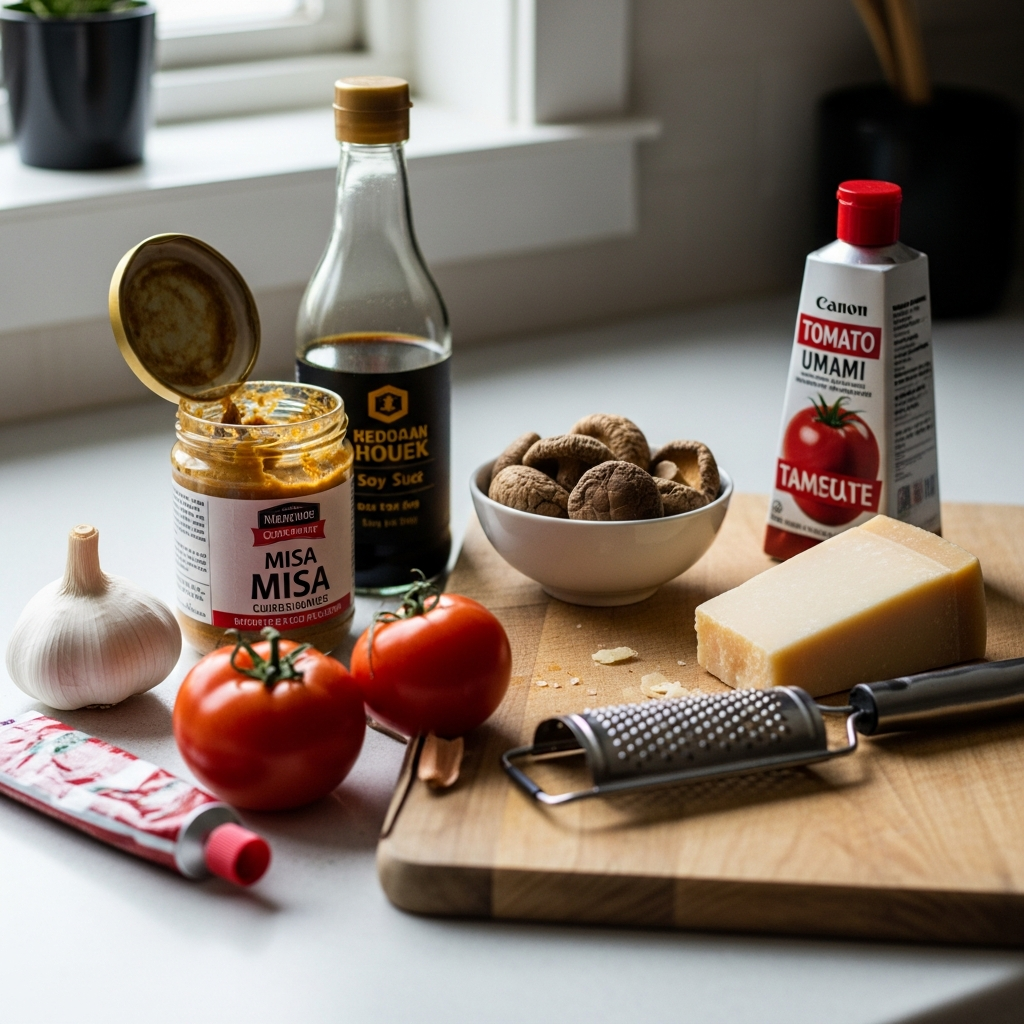
But what is umami? In essence, it’s a fifth taste— its own receptor category, completely separate from salty, sweet, sour, or bitter. But it’s much more than that. It’s triggered by two distinct compound types: free glutamate, showing up in tomatoes, parmesan, miso, and soy sauce, and nucleotides, which live in meat, fish, and mushrooms. Together— or even separately— these compounds create that sense of depth and satisfaction that lingers after you swallow. That feeling that a dish is complete rather than just technically edible.
Here’s the diagnostic I now use constantly. If a dish is properly salted— you’ve tasted it, the seasoning is right— but something still feels off, it’s probably missing umami. Salt and umami are not the same problem. Salt seasons. Umami adds depth. Dumping more salt into a flat dish that’s already well-seasoned just makes it salty. Richer? No. More satisfying? Not even close. Figuring out which problem you’re actually solving is the most useful thing I’ve learned in a kitchen, and honestly, it took me an embarrassingly long time to get there.
The 7 Pantry Umami Ingredients and How to Use Each
Probably should have opened with this section, honestly. None of these are specialty items requiring an online order and a two-week wait. These are things sitting in most home kitchens right now— some actively used, some quietly expiring in the back of a cabinet. The issue was never access. It’s knowing the specific technique that makes each one actually work.
1. Parmesan Rind
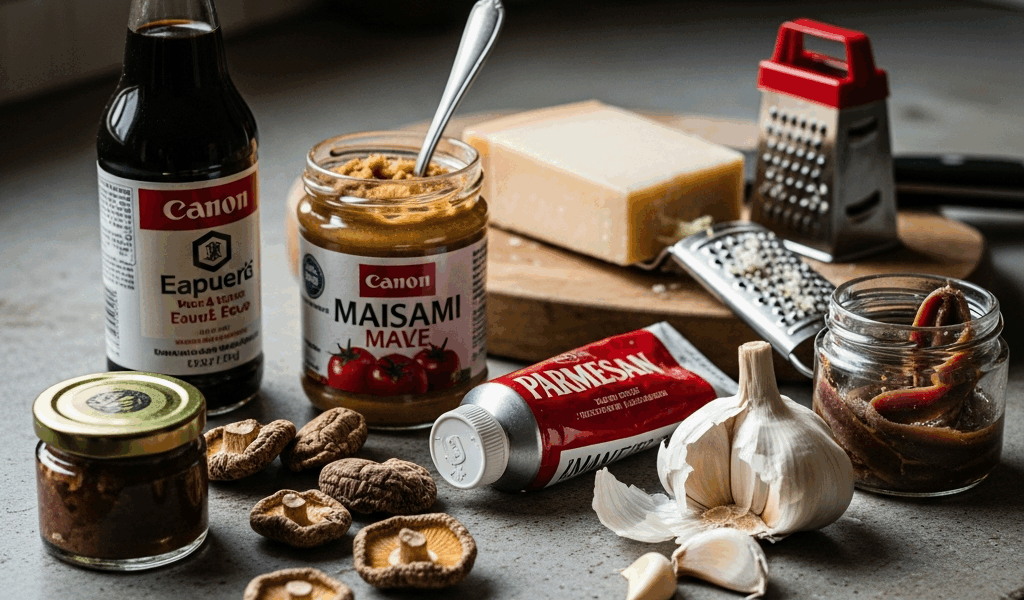
Stop throwing these away. The hard, waxy outer edge of a Parmigiano-Reggiano wedge is packed with concentrated glutamate— more than the cheese itself, gram for gram. Drop one into a soup, stock, or braise at the start of cooking and let it simmer alongside everything else. It slowly releases a deep, savory richness into the liquid that nothing else quite replicates. Fish it out before serving. I keep a zip-lock bag in my freezer specifically for rinds— currently holding four from a $9 Whole Foods 365 wedge and two from a nicer one my neighbor brought over. A single rind will transform a pot of minestrone. Don’t make my mistake and toss them.
2. Tomato Paste
Not just as an ingredient— as a cooked ingredient. That distinction matters more than most recipes bother to explain. Squeezing tomato paste directly into liquid accomplishes very little in terms of depth. Cook it in oil first, in the pan, for two to three minutes until it darkens slightly and turns fragrant— that’s when the glutamate concentrates and light caramelization starts doing real work. That two-minute step is the difference between a sauce that tastes like tomatoes and a sauce that tastes like something serious. I use Muir Glen double-concentrated paste in the tube— around $4, lives in the fridge door for months.
3. Miso
Miso goes in at the end. Non-negotiable. Sustained heat wrecks the nuanced flavor compounds that make miso worth using beyond its salt content. Whisk a tablespoon into a ladle of warm liquid first, then stir that slurry back into the pot right before serving. White miso— shiro— is the most versatile entry point. Sweeter, less intense than red, and genuinely works in salad dressings, compound butter, vegetable glazes, even pan sauces. It’s not just for Japanese food. The best thing I’ve ever done by accident was dissolving a spoonful of white miso into the drippings from a roast chicken. Did it on a whim. Made it on purpose every time since.
4. Fish Sauce
One teaspoon. That’s the dose. One teaspoon of fish sauce added to a tomato pasta sauce, a beef stew, or a stir fry does not make the dish taste like fish. It disappears entirely into the background and adds a savory backbone that makes everything taste more like itself— more defined, more complete. I was genuinely intimidated by this for years. Tried it once. Never went back. Red Boat 40°N is widely considered the gold standard— about $10 for a 250ml bottle that lasts six months of regular cooking. The return on investment is kind of absurd when you think about it.
5. Soy Sauce or Tamari
Same principle as fish sauce— small amounts, used strategically, not as a dominant flavor but as a depth builder working in the background. A teaspoon in a beef braise or dark gravy is nearly impossible to detect as its own flavor— but the dish without it tastes noticeably flatter. Tamari is the better call if you’re cooking gluten-free. San-J tamari in the large bottle is what I reach for. Also works brilliantly in salad dressings where you want more complexity without throwing another strong flavor into the mix.
6. Dried Mushrooms and Mushroom Powder
Dried porcini or shiitake mushrooms are doing two jobs simultaneously— adding nucleotides and reconstituting into something with a genuinely meaty, earthy texture. The soaking liquid is liquid gold. Full of dissolved glutamate and nucleotides, and most people pour it straight down the drain. Strain it through a paper towel to remove grit, then add it to whatever’s in the pot. Mushroom powder— either purchased or made by blending dried mushrooms in a spice grinder for about thirty seconds— mixes directly into ground meat, spice rubs, and sauces without adding any texture. A tablespoon worked into a pound of ground beef before forming burger patties is a trick worth memorizing immediately.
7. Anchovies
Two anchovy fillets pressed into olive oil at the start of a braise or pasta sauce will dissolve completely within two minutes of heat. They leave zero fishy flavor— what they leave is an extraordinary savory depth you’ll notice the second you make the dish without them and can’t figure out why it’s not landing the same way. That happened to me. Stopped using anchovies for a stretch, made several batches of bolognese that tasted progressively more disappointing, couldn’t isolate the problem. Eventually traced it back. Anchovies. Reinstated immediately. Ortiz brand in olive oil runs about $5 a tin and is worth every cent.
Umami Synergy— Why Some Combinations Hit Harder
This is the section that changed how I think about building a recipe from scratch. Glutamate and nucleotides don’t simply add together— they multiply each other. Research on taste receptor activation shows the combination produces an effect dramatically more powerful than either compound would generate alone. It’s not incremental. It’s synergistic in the strict sense— two things producing an outcome neither could reach independently.
Italian Sunday gravy is the clearest example most people have already tasted. Tomatoes are extremely high in glutamate. Meat carries inosinate, a nucleotide. Put them together and cook for hours— the combination creates a depth that neither ingredient could produce on its own. That’s why Sunday gravy tastes like it does. That’s what makes it — it’s not magic, it’s chemistry, and once you understand it you can build it deliberately.
Other combinations where this kicks in reliably:
- Parmesan with prosciutto or any cured meat— glutamate plus nucleotides in a single bite
- Mushrooms added to any meat braise— their nucleotides amplify the meat’s existing umami load
- Miso glaze on salmon or pork— fermentation-derived glutamate colliding with animal nucleotides
- Tomato paste cooked into ground beef for tacos or bolognese— classic combination, consistent results
- Soy sauce in a mushroom stir fry— layering nucleotides from the mushrooms with glutamate from the soy
Once you recognize the glutamate-plus-nucleotide pattern, you start seeing it everywhere in dishes people describe as deeply satisfying. That pattern isn’t accidental. Build it on purpose.
Building Umami Without Meat
Vegetarian cooking has a specific structural problem here— meat and fish are the most concentrated natural sources of nucleotides. Without them, you’re effectively working with one hand behind your back unless you compensate deliberately. The approach that actually works: maximize glutamate sources and identify the plant-based nucleotide options that genuinely exist.
Kombu might be the best option in this category, as vegetarian cooking requires a reliable nucleotide source. That is because a single four-inch piece of dried kombu simmered in two cups of water for twenty minutes produces a liquid with a striking glutamate concentration— kombu contains more free glutamate by weight than nearly anything else on the planet. Dried shiitake mushrooms contain guanylate, which is a nucleotide. Combine kombu and shiitake in the same stock and the synergistic effect appears without any animal product involved. This is the basis of Japanese vegetarian dashi— and it works because the underlying chemistry doesn’t care whether the source is plant or animal.
Nutritional yeast is genuinely underused outside of vegan cooking. High in glutamate, adds a nutty, savory, slightly cheesy quality— and it works as a finisher rather than a cooking ingredient. Two tablespoons over pasta, roasted vegetables, or honestly just popcorn adds real depth without overwhelming anything. Bragg brand is easy to find. About $8 for a canister that lasts for months.
Fermented foods broadly— miso, soy sauce, kimchi, quality vinegar— all carry fermentation-derived glutamate. The fermentation process breaks down proteins into free amino acids, glutamate included. A tablespoon of kimchi liquid stirred into a vegetable soup, a spoon of miso in a mushroom gravy, soy sauce in a lentil stew— these aren’t flavor additions so much as depth additions. There’s a difference.
For vegetarians who eat dairy, parmesan is extremely high in glutamate and pairs naturally with mushrooms and tomato-heavy dishes to create real synergy without any meat involved whatsoever.
The Umami Finish— Adjusting Depth at the End of Cooking
Most cooking advice about seasoning stops at salt. Taste it, adjust the salt, move on. The habit I’ve built over the past few years adds a second question at the end of every session at the stove: does this need salt, or does it need depth? They feel genuinely different when you taste carefully. A dish needing more salt has a sharp, slightly incomplete quality that salt will fix. A dish needing umami tastes thin— technically fine, not offensive, just forgettable. You’d eat it without complaint. You wouldn’t think about it afterward.
Signs the dish needs more umami specifically:
- Properly salted but still one-dimensional
- Tastes like the sum of its parts rather than something integrated and whole
- You keep adding more of the main ingredient trying to fix it and nothing changes
- It tastes acceptable hot but flat and deflated as it cools
The finish techniques that work fastest:
A teaspoon of fish sauce stirred in two minutes before plating. A parmesan rind that’s been simmering for the last thirty minutes of a soup— pull it before serving, but the glutamate it released is already there, staying put. A tablespoon of white miso whisked into two tablespoons of warm cooking liquid, then stirred back into the pot off heat. A small splash of soy sauce in a pan sauce built from roast drippings.
None of these make the dish taste like the ingredient you added— that’s the entire point. Used at the right moment and in the right amount, umami ingredients are effectively invisible. The dish just tastes more like what it was supposed to be all along. More complete. More satisfying. Like someone who actually knew what they were doing made it.
Which, after enough time working with these seven ingredients, is exactly what starts to happen.




Stay in the loop
Get the latest home cuisine delights updates delivered to your inbox.