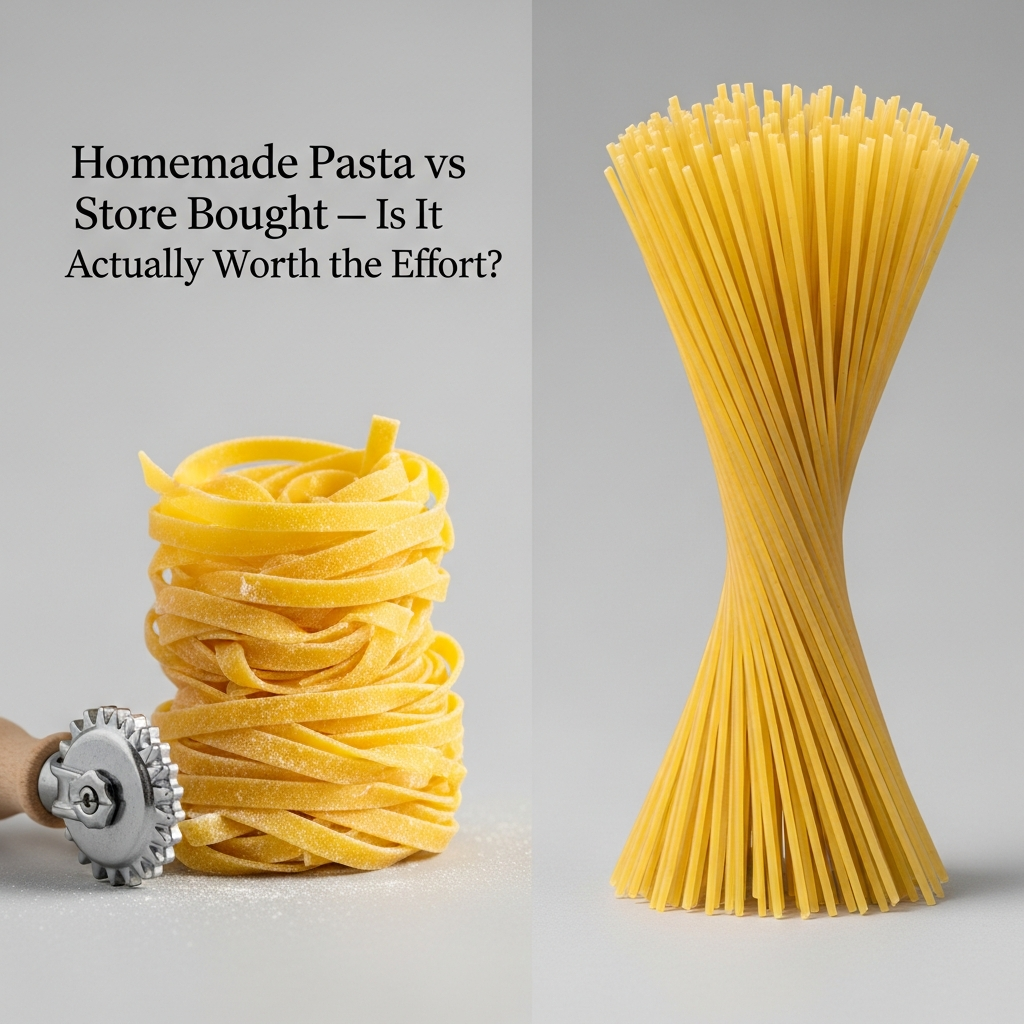
Homemade Pasta vs Store Bought— Is It Actually Worth the Effort?
Homemade pasta has changed with all the romantic mythology flying around. Everyone online acts like pulling out the flour on a Tuesday night is some sacred ritual, and meanwhile I’m standing in my kitchen at 7 p.m. with torn dough sheets and nothing edible to show for an hour of work. As someone who’s been making pasta from scratch for six years— and who still grabs De Cecco off the shelf at least three times a week— when fresh pasta actually matters and when it’s just making your evening worse for no good reason.
Frustrated by one too many floury Wednesday disasters, I finally sat down with a notepad and a glass of wine and worked out exactly what I was getting for my time. What I found shifted how I cook entirely. This is that same reckoning, with actual numbers attached.
This article includes affiliate links. We may earn a commission at no extra cost to you.
The Honest Time and Cost Comparison
Probably should have opened with this section, honestly— because everything else flows from whether the result justifies your time for a given dish. Most articles skip the math entirely. That’s exactly why people stay confused.
Homemade Pasta— The Real Numbers
A basic fresh egg pasta batch for two runs on 200 grams of 00 flour— roughly $0.40 from a 2-pound bag of Antimo Caputo— plus two eggs at about $0.60 each, a drizzle of olive oil, and a pinch of salt. Total ingredient cost lands somewhere between $1.10 and $1.40, depending on what eggs cost in your neighborhood this week.
So yes, the raw ingredients are cheap. Here’s where things get messier.
Active time— meaning time you are physically doing something— runs 45 to 60 minutes for most home cooks. Mixing, kneading for a solid 8 to 10 minutes, the 30-minute rest you absolutely cannot skip, rolling, cutting. A KitchenAid with the pasta roller attachment shaves maybe 10 minutes off. A hand-crank Marcato Atlas 150— which I used for my first three years— means budgeting the full hour, no shortcuts.
Then there’s cleanup. Flour migrates. It gets on the counter, under the roller, somehow on the cabinet handles. Add another 10 minutes just for wiping things down.
Total realistic time: 55 to 70 minutes from decision to pasta hitting boiling water.
Store-Bought Pasta— Also the Real Numbers
A 500-gram box of De Cecco spaghetti costs about $2.49 at most grocery stores. Barilla sits closer to $1.50. Specialty brands like Rustichella d’Abruzzo push toward $5 to $7— but that’s a whole separate conversation. For standard dried pasta, call it $1.50 to $3.00.
Active time: you boil water, salt it generously, drop in the pasta, stir once or twice, drain. Real engagement is maybe 3 minutes. Box to bowl in 10 to 12 minutes for most shapes.
Cleanup is a pot and a colander. That’s it.
So the honest side-by-side:
- Homemade pasta— $1.10–$1.40 in ingredients, 55–70 minutes of your evening, real cleanup involved
- Store-bought pasta— $1.50–$3.00, 10–12 minutes total, minimal mess
Homemade actually costs less on ingredients. But your time has real value— and if fresh pasta doesn’t produce a meaningfully better result for the specific dish you’re making, you’ve just traded an hour of your evening for maybe fifty cents in savings. That’s not a win.
Where Homemade Pasta Actually Wins
There are dishes where fresh pasta isn’t just different— it’s genuinely, noticeably better. These are the ones worth the effort. Not all of them. Just these.
Filled Pasta— Ravioli, Tortellini, Agnolotti
But what is the strongest case for homemade pasta? In essence, it’s this: filled shapes. But it’s much more than a preference— it’s a practical requirement. You cannot make ravioli with dry pasta. That’s just a fact. When you’re folding ricotta-and-lemon-zest filling into thin sheets of egg dough you rolled yourself, the result has no grocery store equivalent at a reasonable price. Fresh ravioli at a specialty shop runs $8 to $14 for two servings. Making it yourself for about $3 in ingredients— even accounting for an hour— makes genuine sense if you’re feeding more than two people or cooking for a dinner party.
That’s what makes filled pasta . The effort has a clear, undeniable payoff sitting right there on the plate.
Fresh Fettuccine and Pappardelle With Delicate Sauces
Fresh fettuccine with real brown butter and sage is a different dish than dried fettuccine with the same sauce. The texture— silky, slightly tender, rich from the yolks— clings to butter-based sauces in a way dried pasta just doesn’t replicate. Don’t make my mistake of assuming this is snobbery. It’s physical. The surface behaves differently.
I tested this deliberately once: same sauce, same pan, same night— half the batch was fresh pasta I’d just made, the other half was a nest of dried Cipriani egg tagliatelle from my pantry. The fresh pasta won clearly. My partner, who genuinely does not care about food the way I do, commented on the difference without being prompted. That said something.
Wide, flat shapes work best here— fettuccine, pappardelle, tagliatelle. The surface area matters. The tenderness matters. For these dishes, with butter or cream-based sauces, homemade earns its hour.
Lasagna Sheets
Homemade lasagna sheets produce a genuinely different lasagna. Thinner, more tender, less starchy between the layers. If you’re already spending four hours on a proper Bolognese, the pasta layer should be delicate— not thick and gummy. Dry lasagna noodles, even the no-boil kind, add bulk without character. Fresh sheets keep the focus where it belongs: the sauce.
Worth making? Yes— but only when the lasagna is already a dedicated project. A Sunday dish. Not Tuesday. Never Tuesday.
Where Store-Bought Is Better (Yes, Really)
This is the section most cooking sites won’t write because it feels like admitting defeat. It isn’t defeat. It’s just being honest.
Al Dente Spaghetti and Long Dried Shapes
Fresh pasta cannot do what dried spaghetti does when cooked properly. That real resistance, the slight firmness at the center at the 10-minute mark— fresh pasta doesn’t produce that. Fresh pasta cooks in 2 to 3 minutes and goes tender. Dried spaghetti at 9 to 11 minutes develops actual structure. Apparently even many Roman restaurants use dried tonnarelli or spaghetti for cacio e pepe— the starch release from dried pasta helps the sauce emulsify correctly.
Spaghetti aglio e olio. Puttanesca. Spaghetti alle vongole. These dishes want dried pasta. The chew is part of the experience— not a consolation prize.
Baked Dishes and Hearty Meat Sauces
Fresh pasta can get completely lost inside a heavy, long-cooked meat sauce. Baked ziti, pasta al forno, rigatoni with Sunday Bolognese— the pasta needs to hold its shape under sustained heat and moisture. Dried rigatoni does that. Dried penne does that. Fresh pasta turns to mush, and the delicate silkiness that makes it special gets entirely masked by a robust sauce anyway.
You’d be spending an extra hour to produce a result the $2 box achieves better. That’s just true, and it’s worth saying plainly.
Weeknights
Don’t make my mistake. Twice I tried fresh pasta on a Tuesday after work— already tired, dinner needing to happen by 7 p.m. Both times I rushed the dough rest. The sheets tore. The texture was mediocre. The pasta was worse than if I’d used dry, and I was frustrated and still hungry while trying to salvage it. Fresh pasta made under time pressure is usually not as good as fresh pasta made when you have actual time— and dry pasta, cooked in heavily salted water with the right timing, is genuinely excellent.
Give yourself permission. The box is fine. The box is often exactly the right call.
The Verdict— When to Make It and When to Skip It
Here’s the clear answer this question actually deserves— no hedging, no both-sidesing it.
Make homemade pasta when:
- You’re making filled pasta— ravioli, tortellini, any stuffed shape
- You’re making wide egg pasta (fettuccine, pappardelle) with a butter-based or cream-based sauce and you have 90 minutes
- It’s a special occasion, a Sunday project, or you’re cooking because you want to enjoy the process itself
- You’re making lasagna as a dedicated project dish
- You have the time, the space, and nowhere to be
Use store-bought pasta when:
- It’s a weeknight and dinner needs to happen in under 30 minutes
- You’re making spaghetti, rigatoni, penne, or any short dried shape
- The sauce is robust, hearty, or long-cooked— it will overpower any fresh pasta advantage anyway
- You’re baking the pasta in any form
- You want real al dente texture
This new idea— that fresh and dried pasta serve genuinely different purposes— took off in my kitchen several years after I started making pasta, and eventually evolved into the framework home cooks know and actually use today. Fresh pasta isn’t universally better. Dried pasta isn’t a compromise. They’re different tools, and knowing which one to reach for is what good cooking actually looks like.
Special occasion, filled pasta, delicate sauce: make it from scratch. Tuesday night, spaghetti, 45 minutes until dinner: reach for the De Cecco. The hour you save on a weeknight is an hour you can spend making a really good sauce. That trade is almost always worth it.



Stay in the loop
Get the latest home cuisine delights updates delivered to your inbox.