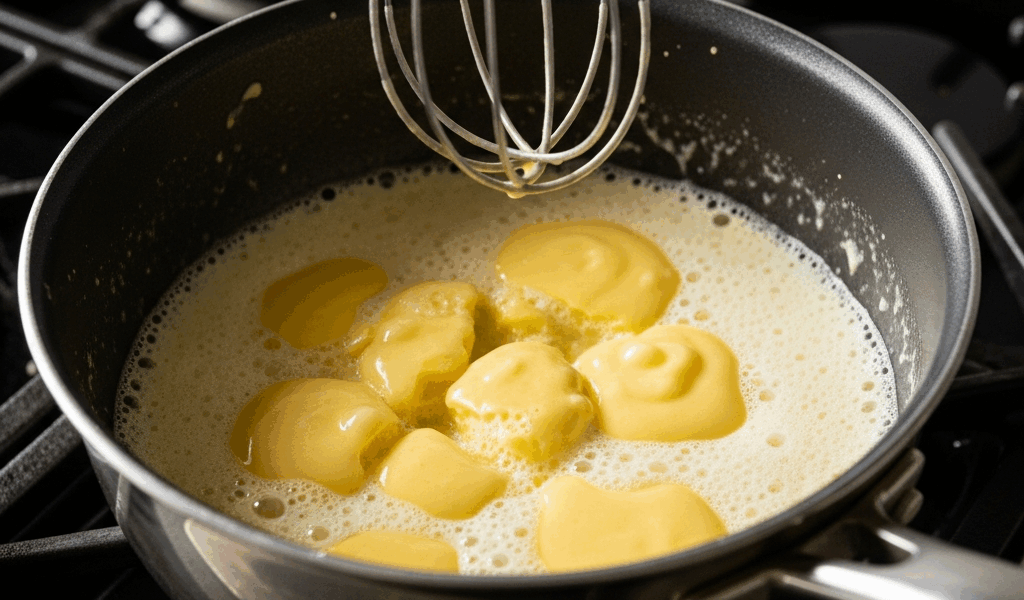
What Happens When Hollandaise Breaks
Your hollandaise sauce breaks. Not occasionally—every single time. And right now, while you’re standing there whisking, it’s separating into a greasy, curdled mess that looks like scrambled eggs mixed with butter.
I spent three years making hollandaise for eggs Benedict at a small brunch spot before I understood what was actually happening. The sauce would split. The yolks would curdle. I’d watch the beautiful, glossy emulsion turn into something I couldn’t serve, and I had no idea why.
But what is hollandaise, really? In essence, it’s an emulsion—you’re forcing tiny droplets of melted butter to suspend evenly throughout a water-based egg yolk mixture. Think of it like oil and vinegar in salad dressing. They don’t naturally want to mix, so you need an emulsifier (the egg yolk) to hold them together. When your sauce breaks, that emulsion fails. The fat separates. The egg proteins either get too hot and scramble, or they can’t absorb any more butter. The result is greasy, split, separated disaster.
That’s what makes understanding this endearing to anyone who’s had to remake hollandaise three times before service. Knowing exactly why this happens means you can fix it mid-cook. Or prevent it entirely next time.
The Three Reasons Your Hollandaise Breaks
Reason One — Temperature Is Too High or Uneven
This is the most common culprit. Egg yolks scramble around 158°F (70°C). If your bowl is sitting directly over boiling water, or if you’re whisking over direct heat, you’re cooking the yolks too fast. The proteins denature. The emulsion collapses.
Here’s what it looks like while you’re making it: the sauce thickens for a moment, then suddenly becomes grainy. You’ll see tiny flecks of cooked egg throughout. The texture gets dull and broken instead of glossy—it might separate into a greasy puddle with white-yellow bits floating in it.
Temperature unevenness is sneaky, honestly. Your bowl might be cool on the sides but boiling hot on the bottom where it touches the water. Some sections of your sauce cook faster than others, and the whole thing destabilizes.
Reason Two — You’re Adding Butter Too Fast
The egg yolks can only absorb so much fat at a time. This isn’t a guess—it’s a real limit based on the yolk’s lecithin content, which tops out around 3 to 4 ounces of butter per yolk. Add butter faster than the yolks can incorporate it, and the emulsion breaks.
Probably should have opened with this section, honestly. This mistake killed more of my hollandaise batches than anything else.
Watch for this sign: your sauce starts out looking good and silky. Then, halfway through adding the butter, it suddenly turns from glossy to thick and separated. It might look shiny on top with a layer of grease pooling around the sides. The texture shifts from smooth to grainy or chunky. This happens because you poured too much butter in too quickly, overwhelmed the yolks, and they gave up.
Reason Three — Your Yolk-to-Butter Ratio Is Wrong
One egg yolk can hold, reliably, about 3 to 4 ounces of butter—no more. If your recipe calls for 6 ounces of butter and only one yolk, it won’t work. The yolk physically cannot absorb that much fat.
This one reveals itself gradually. Your sauce starts out creamy, but it gets thicker and thicker as you add butter. Then, suddenly, it breaks. It becomes grainy, oily, or separated. Sometimes it looks almost curdled. The sauce loses that silky, pourable consistency and becomes heavy and broken instead.
The fix is simple: you need more yolks or less butter. A standard ratio is one yolk per 3 to 4 ounces of butter. If you’re making a larger batch, scale the yolks proportionally.
How to Fix Broken Hollandaise Right Now
Your sauce is already split. Don’t panic—this is fixable in about 60 seconds.
Grab a clean bowl. Add a single fresh egg yolk (cold from the fridge is fine here). Whisk it gently for a few seconds until it’s slightly broken up. Now, slowly drizzle your broken sauce into this yolk while whisking constantly. Start with just a few drops. Tiny drops. Watch as the yolk re-emulsifies the broken sauce.
Keep going. As it thickens and looks glossy again, you can pour a bit faster—but not much. Small, steady stream. Keep whisking. Within a minute or so, your broken sauce should turn back into smooth, creamy hollandaise.
If it starts to break again while you’re doing this rescue, stop. Add a teaspoon of cold water and whisk hard for a few seconds before continuing. The water helps re-stabilize the emulsion.
Why does this work? You’re giving the broken fat droplets a fresh egg yolk to cling to. The lecithin in that new yolk acts like a bridge, holding the fat and water phases back together.
The Right Way to Make It So It Doesn’t Break
Start with the setup. Use a double boiler—a bowl sitting over a pot of water. The water should be barely simmering, not rolling. The bowl shouldn’t touch the water. This gives you gentle, even heat.
Room-temperature butter is essential. Cold butter straight from the fridge does two things wrong: it shocks your sauce with temperature changes, and it takes longer to incorporate, which throws off your timing. Take it out about 15 minutes before you start cooking. It should be soft enough to pour easily, not stiff.
Use three large egg yolks. Whisk them together with a splash of cold water (about a tablespoon) and a pinch of salt. This goes in your bowl first, over the double boiler. Whisk constantly for about a minute until it’s pale and slightly thickened. You’re building the base.
Now comes the critical part: adding the butter. Start with just a few drops—a teaspoon at a time. Whisk constantly. You’re watching for the sauce to thicken and turn glossy. Once it’s taken in that first small amount, you can increase to a thin, steady drizzle, like the thinnest stream of oil pouring from a bottle. Keep whisking. This should take 5 to 7 minutes total.
Finish with lemon juice (about 1 tablespoon) and a pinch of cayenne pepper. Taste. Adjust salt if needed.
The pro tip: add a splash of cold water once your sauce is done—just a teaspoon or two. Whisk it in. This stabilizes the emulsion for another 20 to 30 minutes. The water gives you a buffer. Your sauce will stay glossy and pourable even if it sits for a bit.
Common Mistakes That Sneak Up on You
You know the main three reasons now. But these smaller mistakes compound the problem.
Rushing the process is the biggest one. I’ve seen cooks try to make hollandaise in two minutes flat. You can’t. The emulsion needs time to form properly. Those 5 to 7 minutes of slow butter addition aren’t optional—they’re the whole point. Rushing guarantees failure.
Using cold butter straight from the fridge is another killer. It melts unevenly. Some of it is liquid, some is still solid. Your sauce struggles to incorporate it smoothly. The temperature drops. Everything destabilizes.
Whisking too vigorously, especially at the start. You want steady, consistent whisking, not aggressive beating. Too much air and vigorous motion can actually break the emulsion, especially when the yolks haven’t yet formed a stable base.
Ignoring the steam’s heat. Even if your water isn’t boiling hard, the steam rising from it adds heat to your bowl. If your double boiler setup is too close together or too well-sealed, your sauce might heat too fast without you realizing it. Keep an inch of air between the water’s surface and your bowl’s bottom.
All of these circle back to the three main reasons: temperature control, butter speed, and ratio. Once you know which one is your actual problem, you’ll stop breaking hollandaise. You might even start enjoying making it.




Stay in the loop
Get the latest home cuisine delights updates delivered to your inbox.