Umami in Home Cooking — 7 Ingredients Already in Your Pantry That Build Deeper Flavor
What Umami Actually Is and Why Your Cooking Might Need It
Umami ingredients for home cooking are something I spent years ignoring, not because I dismissed the concept, but because I genuinely thought I was already using them. I was salting my food. I was tasting as I cooked. My pasta sauces were fine. Then a friend made a Sunday gravy at her apartment, and I ate a bowl of it standing over her stove before she’d even set the table, and I thought: what is happening here. It tasted like it had been cooking for a week. Hers had been going for three hours. Mine, same recipe on paper, always tasted thinner. The difference was umami, and I didn’t fully understand that until I started paying attention to which ingredients were actually doing what in a pot.
Here is the short version of the chemistry, and I promise it’s worth knowing. Umami is triggered by two distinct compounds: free glutamate, found in tomatoes, parmesan, miso, and soy sauce, and nucleotides, found in meat, fish, and mushrooms. These compounds activate taste receptors in a way that is completely separate from salty, sweet, sour, or bitter. It is its own dimension. It’s what makes a dish feel complete rather than flat — that sense of depth and satisfaction that lingers slightly after you swallow.
The practical test I now use constantly: if a dish is properly salted — you’ve tasted it, the salt level is right — but it still feels like it’s missing something, it’s missing umami. Salt and umami are not the same problem. Salt seasons. Umami adds depth. Adding more salt to a flat-tasting dish that’s already adequately seasoned will just make it salty. It will not make it taste richer or more complete. Identifying which problem you’re actually solving is the single most useful diagnostic skill in cooking, and it took me embarrassingly long to figure out.
The 7 Pantry Umami Ingredients and How to Use Each
Probably should have opened with this section, honestly. These are not specialty ingredients you need to order online. These are things sitting in most home kitchens right now, either actively used or slowly being ignored. The issue isn’t access — it’s knowing the specific technique that makes each one work.
1. Parmesan Rind
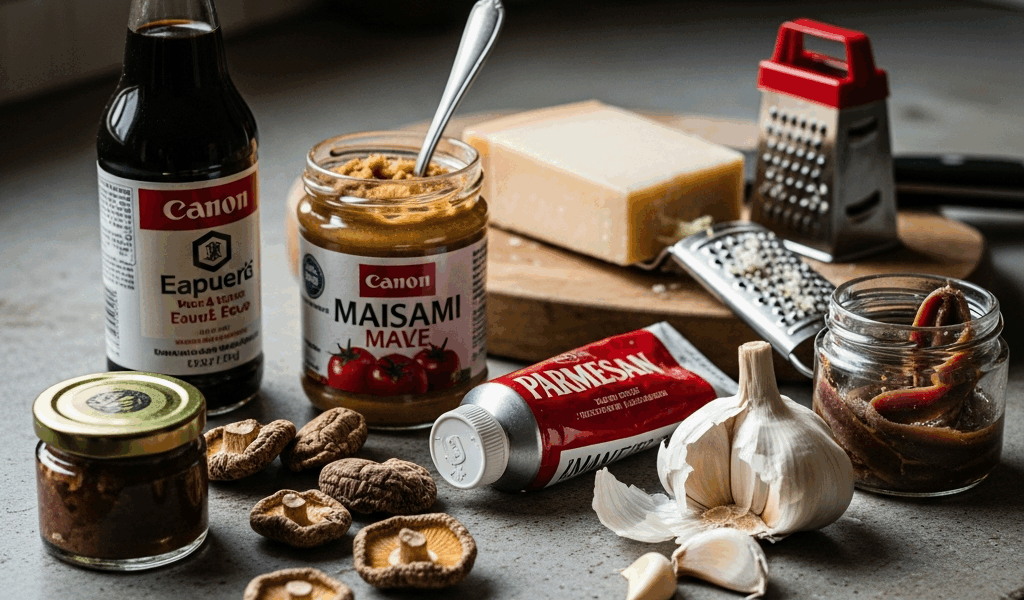
Stop throwing these away. The rind of a wedge of Parmigiano-Reggiano — the hard, waxy outer edge — is intensely concentrated with glutamate. Drop one into a soup, stock, or braise at the beginning of cooking and let it simmer with everything else. It slowly releases a deep, savory richness into the liquid. Fish it out before serving; you don’t eat the rind itself. I keep a zip-lock bag in the freezer specifically for rinds. A single rind from a $9 wedge of Whole Foods 365 parmesan will transform a pot of minestrone in a way that nothing else replicates.
2. Tomato Paste
Not just as an ingredient — as a cooked ingredient. This distinction matters more than most recipes acknowledge. Squeezing tomato paste directly into liquid does very little for depth. Cooking it in oil first, in the pan, for two to three minutes until it darkens slightly and becomes fragrant, concentrates the glutamate and allows some light caramelization. That two-minute step is the difference between a sauce that tastes like tomatoes and a sauce that tastes like something serious. I use the Muir Glen double-concentrated paste in the tube — costs about $4, lasts forever in the fridge.
3. Miso
Miso goes in at the end. This is non-negotiable. Sustained heat degrades the nuanced flavor compounds that make miso valuable beyond just salt. Whisk a tablespoon of white miso into a ladle of warm liquid first, then stir that back into the pot right before serving. White (shiro) miso is the most versatile starting point — sweeter and less intense than red. Works in salad dressings, compound butter, braises, and roasted vegetable glazes. Not just for Japanese food. A small amount of miso dissolved into the pan drippings from a roast chicken is one of the best things I’ve ever done by accident.
4. Fish Sauce
One teaspoon. That’s the dose. One teaspoon of fish sauce in a tomato pasta sauce, a beef stew, or a stir fry does not make the dish taste like fish. It disappears completely into the background and adds a savory backbone that makes everything taste more like itself. Intimidated by this for years, tried it, never went back. Red Boat 40°N is widely considered the best quality — it runs about $10 for a 250ml bottle. That bottle will last you six months of regular cooking. The return on investment is genuinely absurd.
5. Soy Sauce or Tamari
Same principle as fish sauce — small amounts, used strategically, not as a dominant flavor but as a depth builder. A teaspoon of soy sauce in a beef braise or a dark gravy is nearly impossible to detect as a distinct flavor, but the dish without it tastes noticeably flatter. Tamari is the better choice if you’re cooking gluten-free. San-J tamari in the large bottle is what I use. Also works brilliantly in salad dressings where you want more complexity without adding another strong flavor.
6. Dried Mushrooms and Mushroom Powder
Dried porcini or shiitake mushrooms are doing two jobs: they are adding nucleotides (more on why that matters in a moment) and they reconstitute into something with a meaty, earthy texture. The soaking liquid is liquid gold — full of dissolved glutamate and nucleotides. Do not pour it down the drain. Strain it through a paper towel to remove grit and add it to whatever you’re cooking. Mushroom powder, which you can either buy or make by blending dried mushrooms in a spice grinder, mixes directly into ground meat, rubs, and sauces without any texture. A tablespoon of mushroom powder in a pound of ground beef for burgers is a trick worth memorizing.
7. Anchovies
Two anchovy fillets, pressed into olive oil at the start of cooking a braise or pasta sauce, will dissolve completely within two minutes of heat. They leave no fishy flavor. What they leave is an extraordinary savory depth that you will notice immediately if you ever make the dish without them and wonder why it’s not as good. Knocked out of the habit of using anchovies once, cooked several batches of bolognese that tasted progressively more disappointing, couldn’t figure out what had changed. Eventually traced it back. Anchovies. Reinstated them immediately. Ortiz brand in olive oil, about $5 a tin.
Umami Synergy — Why Some Combinations Hit Harder
This is the part that changed how I think about recipe construction. Glutamate and nucleotides don’t just add together — they multiply. Research on taste receptor activation consistently shows that the combination of glutamate-rich ingredients and nucleotide-rich ingredients produces an effect dramatically more powerful than either would produce alone. The increase in perceived umami intensity from combining these two compound types is not incremental. It is synergistic in the strict sense of the word.
Italian Sunday gravy is the most intuitive example. Tomatoes are extremely high in glutamate. Meat contains inosinate, a nucleotide. Put them together for hours and the combination creates a depth of flavor that neither could produce independently. That’s why Sunday gravy tastes like it does. That’s why a slow-cooked meat sauce doesn’t taste like tomato sauce with meat added — it tastes like something categorically different.
Other combinations where this kicks in hard:
- Parmesan with prosciutto or any cured meat — glutamate plus nucleotides in one bite
- Mushrooms in any meat braise — the mushrooms’ nucleotides amplify the meat’s existing umami load
- Miso glaze on salmon or pork — fermentation-derived glutamate meeting animal nucleotides
- Tomato paste cooked into ground beef for tacos or bolognese — classic, consistent, always works
- Soy sauce added to a mushroom stir fry — layering nucleotides from mushrooms with glutamate from soy
Once you see the glutamate-plus-nucleotide pattern, you start recognizing it everywhere in dishes that are known to be deeply satisfying. The pattern isn’t accidental. Build it deliberately.
Building Umami Without Meat
Vegetarian cooking faces a specific challenge here: meat and fish are the most concentrated natural sources of nucleotides. Without them, you’re operating with one hand behind your back unless you deliberately compensate. The solution is to maximize glutamate sources and hunt down the plant-based nucleotide options that do exist.
Kombu is the most powerful tool in this category. A single four-inch piece of dried kombu simmered in two cups of water for 20 minutes produces a liquid with a remarkable glutamate concentration — kombu contains more free glutamate by weight than almost anything else. Dried shiitake mushrooms contain guanylate, which is a nucleotide. Combine kombu and shiitake mushrooms in the same stock and you get the synergistic effect without any animal products. This is the basis of Japanese vegetarian dashi, and it works because the chemistry is real regardless of whether the ingredients are plant or animal in origin.
Nutritional yeast is underused outside of vegan cooking circles. It’s high in glutamate, it adds a nutty, savory, slightly cheesy quality, and it works as a finisher rather than a cooking ingredient. Two tablespoons over pasta, popcorn, or roasted vegetables adds genuine depth. Bragg brand is widely available. About $8 for a canister that lasts months.
Fermented foods across the board — miso, soy sauce, kimchi, good quality vinegar — all benefit from fermentation-derived glutamate. The fermentation process breaks down proteins into free amino acids, including free glutamate. A tablespoon of kimchi liquid in a vegetable soup, a spoon of miso in a mushroom gravy, soy sauce in a lentil stew — these are not flavor additions so much as depth additions.
For vegetarians who eat dairy, parmesan is extremely high in glutamate and pairs naturally with mushrooms and tomato-heavy dishes to create real synergy without meat.
The Umami Finish — Adjusting Depth at the End of Cooking
Most cooking advice about seasoning stops at salt. Taste it, adjust the salt, done. The habit I’ve built over the past few years adds a second question at the end of every cooking session: does this need salt, or does it need depth? They feel different when you taste carefully. A dish that needs more salt tastes sharp and slightly incomplete in a way that salt will fix. A dish that needs umami tastes thin — technically correct, not offensive, but forgettable. You’re not excited about it. You’d eat it without complaint but wouldn’t think about it afterward.
Signs the dish needs more umami specifically:
- Properly salted but still one-dimensional
- Tastes like the sum of its parts rather than something integrated
- You keep adding more of the main ingredients trying to fix it and nothing changes
- It tastes fine hot but flat as it cools
The finish techniques that work fastest:
A teaspoon of fish sauce stirred into a pasta sauce two minutes before plating. A parmesan rind that has been simmering for the last 30 minutes of a soup — pull it before serving, but the glutamate it released stays. A tablespoon of white miso whisked into two tablespoons of warm cooking liquid, then added back to the pot off heat. A small splash of soy sauce in a pan sauce made from roast drippings.
None of these make the dish taste like the ingredient you added. That’s the point. Used correctly, umami ingredients are invisible. The dish just tastes more like what it was supposed to be. More complete. More satisfying. Like someone who knew what they were doing made it.
Which, after enough repetition with these seven ingredients, is exactly what will start to happen.



Stay in the loop
Get the latest home cuisine delights updates delivered to your inbox.