How to Tell What Actually Went Wrong
Sunken cakes have gotten complicated with all the conflicting advice flying around. Baking forums say one thing. Your grandmother says another. The recipe card says nothing useful at all.
Here’s the thing most articles skip: when the sink happens tells you exactly what caused it. Did your cake rise beautifully, then crater the second you pulled it from the oven? That’s one problem entirely. Did it slowly slump inward while still baking? Different problem. Did the edges look perfect while the center stayed suspiciously wet? That’s a third failure mode— and each one has its own fix.
No vague troubleshooting lists here. Just a real diagnostic path. So, without further ado, let’s dive in.
Too Much Leavening Is Usually the Culprit
Probably should have opened with this section, honestly.
Frustrated by a cake that rose too slowly one Sunday afternoon, I added what felt like “a generous pinch extra” of baking powder— maybe an extra half teaspoon— to hurry things along. The cake looked absolutely stunning around the twelve-minute mark. Then it peaked like a small volcano and folded into a dense, crumbled crater. The whole thing took maybe forty seconds to die.
But what is overleavening, exactly? In essence, it’s adding more gas-producing agent than the batter’s protein and starch structure can physically support. But it’s much more than that. Excess baking powder or baking soda generates bubbles faster than the surrounding batter can set and hold them. The cake rockets upward— then has nothing strong enough to keep it there. The bubbles rupture, merge, and the whole center gives out.
The counterintuitive part: more leavening doesn’t mean more rise. It means a bigger fall. Don’t make my mistake.
The standard ratio is 1 teaspoon of baking powder per 1 cup of flour. Two cups of flour needs exactly 2 teaspoons— not 2.5, not a heaping spoonful. A basic kitchen scale ($12–18 on Amazon, I use an Etekcity model) eliminates the ambiguity entirely. One level teaspoon of baking powder weighs roughly 5 grams. Weigh it once and you’ll never eyeball it again.
Baking soda is even less forgiving. The ratio tightens to about ¼ teaspoon per cup of flour when it’s your only leavening agent. A violent reaction sets in fast when you overshoot it— and the collapse follows just as fast.
I’m apparently a chronic over-measurer and the Etekcity scale works for me while measuring spoons never really worked. Level your spoons with a straight knife edge at minimum. That small habit saves a lot of cakes.
Opening the Oven Door Too Early Wrecks Everything
You want to peek. Completely understandable. Also completely the enemy of a good cake.
Inside the oven, your cake is a fragile web of unset proteins and starches, inflated by gas bubbles that haven’t locked into place yet. Open that door and cold air rushes in— temperatures can drop 25°F in seconds. Those bubbles contract before the batter solidifies around them. The outer edges, already firmed up by the heat, hold their shape. The center, still soft and vulnerable, collapses inward.
That’s what makes the early bake window so critical to us home bakers— we can’t see what’s happening, so we assume something must be wrong. Usually nothing is wrong. The cake is rising exactly as it should. You just can’t see it yet.
Never open the door before 75 percent of your bake time has passed. Thirty-minute recipe? Don’t look until 22 minutes. Forty-minute cake? Wait until at least 30 minutes are on the clock. After that, a quick visual check is safe.
Modern ovens with a light and window feel like a workaround— they’re not. The light creates a small draft every time you lean in to look. During the critical first third of baking, skip it entirely. The psychological comfort is not worth a sunken center.
Underbaking Looks Done but Is Not
The toothpick test is popular. It’s also only half the story.
A clean toothpick means done. Wet batter on the toothpick means more time. But “a few moist crumbs”— that gray zone— trips up most home bakers. A fudgy brownie needs moist crumbs to be right. A vanilla layer cake absolutely does not. Pull a layer cake at the moist-crumb stage and the center is still structurally unresolved. It looks fine coming out of the oven. Within an hour of cooling, it sinks.
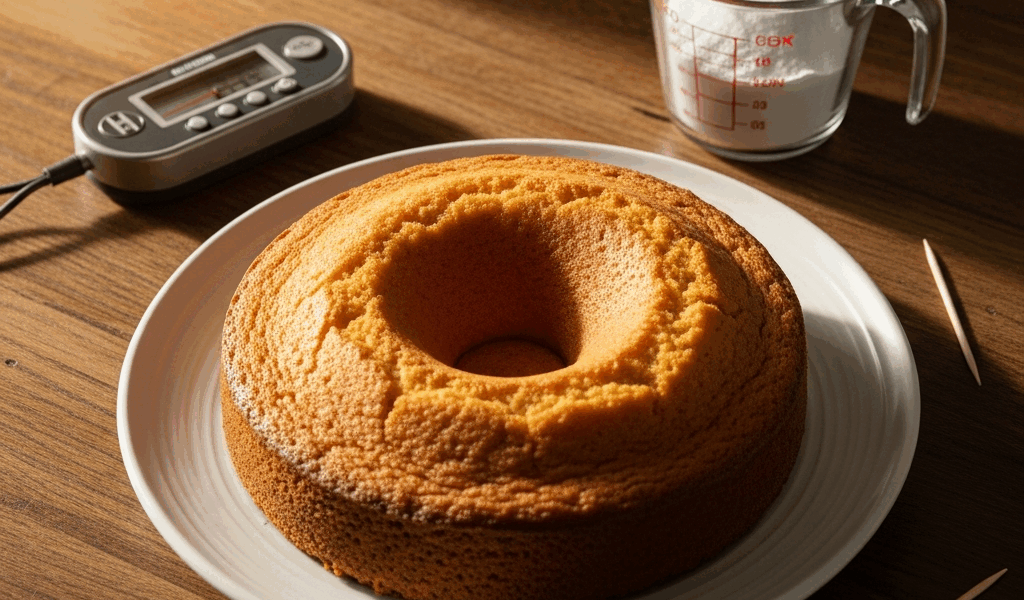
The more reliable test is internal temperature. Most butter cakes are done when the very center hits 200–210°F. A cheap instant-read thermometer— the ThermoPro TP03 runs about $12— removes all the guesswork. Stick it straight into the center. 205°F means done. 195°F means close the door and give it five more minutes.
Yes, overbaking dries cakes out. Nobody wants that. But a properly baked cake— pulled at 205°F— is genuinely tender and moist, not dry at all. Trust the thermometer over your intuition here, at least until you’ve done it enough times to calibrate your instincts to your specific oven.
Pan Size and Oven Temperature Matter More Than You Think
Borrowed a 6-inch round pan one Saturday when my usual 8-inch was still in the dishwasher. Figured it wouldn’t matter much. Poured the batter in, baked it for the original time listed on the recipe card. The edges came out textbook perfect. The center was basically still custard. That was not a great afternoon.
Swapping a 6-inch pan for an 8-inch roughly doubles the batter depth. The bottom and sides cook through while the middle stays raw. When it cools, that unset core collapses— every single time. Check your recipe’s pan size— no substitutions without adjusting bake time, full stop.
Oven temperature is equally critical, and most home bakers ignore it completely. The dial is almost certainly lying to you. Most residential ovens run 15–25°F hotter or cooler than the display shows. An oven thermometer ($8–15, the CDN model is reliable) sits on your rack and tells you the actual temperature. If your dial reads 350°F but the rack reads 330°F, you’ve been underbaking everything for years. If it reads 370°F, your edges overcook while the center lags behind and eventually gives out.
Hot spots are real too. If your oven runs hotter on one side— most do— rotate the pan at the halfway mark. Simple fix, makes a real difference.
Here’s a checklist worth taping inside your cabinet door:
- Verify pan size matches the recipe— adjust bake time for any substitutions
- Confirm actual oven temperature with a rack thermometer before baking
- Measure leavening by weight or leveled spoon, never heaped
- Keep the oven door closed until at least 75 percent of bake time has passed
- Test doneness with an instant-read thermometer aiming for 205–210°F at center
Your next cake won’t sink. The collapse is always one of these five things— and now you know exactly how to find it before it happens.


Stay in the loop
Get the latest home cuisine delights updates delivered to your inbox.