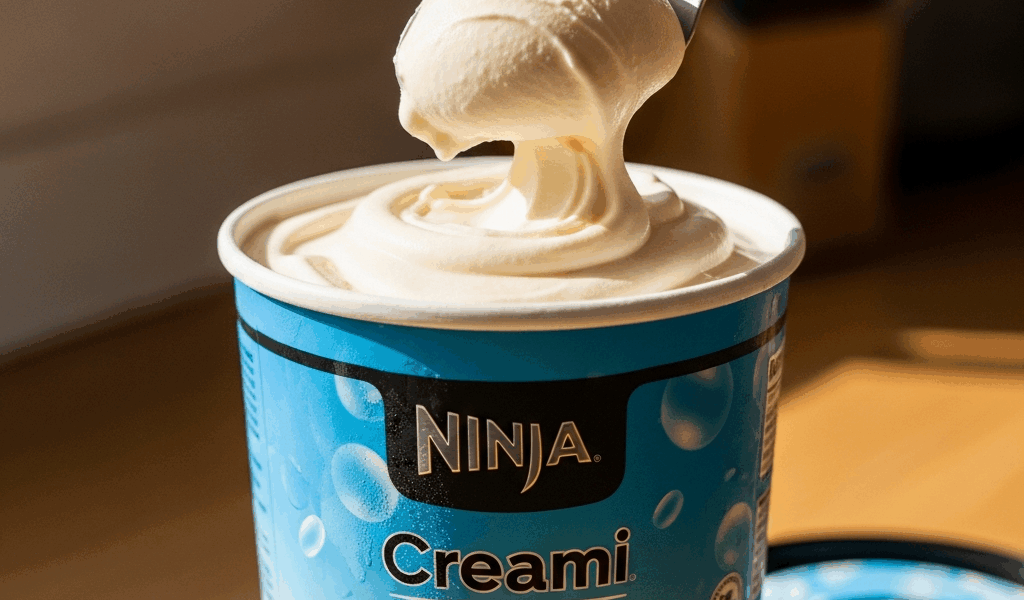
If your Ninja Creami ice cream came out rock-hard or crumbly, the fix usually takes less than two minutes. The problem is almost always freezer temperature, fat content, or freeze time — not the machine itself.
Quick Fix If Your Ninja Creami Ice Cream Is Too Hard Right Now
You have a frozen brick in your pint container. Here is what to do right now:
Option 1 — Hot water bath. Run the outside of the pint container under hot tap water for 30 to 60 seconds. Dry it off and reprocess on the Ice Cream setting.
Option 2 — Counter rest. Set the pint on the counter for 15 to 20 minutes. The edges will soften just enough for the blade to catch.
Option 3 — Re-spin with added liquid. Remove the lid, add 1 to 2 tablespoons of whole milk or heavy cream directly on top, then reprocess. This is the single most effective fix for crumbly results.
If it is still crumbly after the re-spin, add another tablespoon of milk and re-spin again. Most texture problems resolve within two to three re-spins.
Why Ninja Creami Ice Cream Comes Out Hard or Crumbly
Three root causes account for nearly every texture failure. I went through all three of these with my NC301 before I figured out what was actually going on.
1. Freezer temperature is too low. The Ninja Creami works best when pints are frozen between -7 and +9 degrees Fahrenheit. Most home freezers sit around 0 degrees Fahrenheit, which is fine. But if your freezer runs at -10 or below, the pint freezes so solid that the blade skips across the surface instead of shaving it. Check your freezer with a cheap thermometer — mine was sitting at -12 and I had no idea until I actually measured it. Bumped it up to -2 and the difference was immediate.
2. Not enough fat in the base. Fat is what prevents large ice crystals and gives you smooth, scoopable texture. You need a minimum of about 2 percent milk fat in your base. Skim milk, water, and plain almond milk produce icy, crumbly results almost every time. If you are making protein ice cream with water or low-fat milk, add at least 1 tablespoon of heavy cream per pint to get the texture right.
3. Base was not frozen long enough. The pint needs a full 24 hours in the freezer. Anything less and the center stays soft while the edges freeze hard. That inconsistency produces a crumbly, uneven texture on the first spin. Set a timer or freeze overnight plus the following day.
Ninja Creami Temperature and Fat Chart
Use this reference to dial in your base recipe. The minimum fat percentage is the threshold below which you will consistently get crumbly or icy results.
| Base Type | Recommended Fat Source | Minimum Fat Content | Ideal Freezer Temp | Typical Re-Spins Needed |
|---|---|---|---|---|
| Full-fat dairy (whole milk + cream) | Heavy cream, whole milk | 3.5% or higher | -5 to 0 F | 1 |
| Protein ice cream | 1 tbsp heavy cream per pint | 2% minimum | -5 to 0 F | 2 to 3 |
| Sorbet (fruit-based) | None needed (sugar acts as antifreeze) | N/A — use 1/3 cup sugar minimum per pint | 0 to 5 F | 1 to 2 |
| Lite ice cream | 2% milk + 1 tbsp cream | 2% minimum | -5 to 0 F | 2 |
| Almond or oat milk base | 2 tbsp coconut cream per pint | Add fat — plant milks alone are too lean | 0 to 5 F | 2 to 3 |
If you are using a protein powder base, here is the trick that finally worked for me: instant sugar-free pudding mix, about 1 tablespoon per pint. It acts as both a stabilizer and a texture improver. Binds moisture and prevents that grainy, powdery result that low-fat protein bases love to produce. Vanilla pudding mix in a chocolate protein base sounds wrong but you genuinely cannot taste it.
Model-Specific Differences That Affect Texture
Not all Ninja Creami machines process the same way. The motor power difference between models changes how many re-spins you need and how well the machine handles dense or low-fat bases.
Ninja Creami NC301 (Original)
- Motor: 1,350 watts
- Pint size: 16 ounces (2 pints included)
- Programs: 7 (Ice Cream, Sorbet, Lite Ice Cream, Gelato, Milkshake, Smoothie Bowl, Mix-In)
- Texture notes: Handles full-fat dairy bases well on the first spin. Low-fat and protein bases typically need 2 to 3 re-spins. Dense frozen fruit bases may need a 30-second hot water bath before processing.
Ninja Creami NC501 (Deluxe)
- Motor: 1,500 watts
- Pint size: 24 ounces (3 pints included)
- Programs: 11 (adds Slushi, Frozen Drink, Creamiccino, Italian Ice)
- Texture notes: The stronger motor processes rock-hard pints more reliably. Fewer re-spins needed across all base types. The larger pint size means more liquid volume, which generally produces smoother results. The Top/Bottom Processing feature lets you process just the top half — useful when the bottom is still too frozen.
Ninja Creami NC300 (Original, Earlier Version)
- Same 1,350-watt motor as the NC301
- Pint size: 16 ounces
- The NC300 and NC301 perform identically for texture. The NC301 is the updated version with minor design changes but the same motor and blade assembly.
If you have the NC301 or NC300 and consistently get crumbly results with protein bases, the hot water bath before processing makes the biggest difference. The NC501’s extra 150 watts of motor power reduces (but does not eliminate) the need for this step.
When to Re-Spin vs When to Start Over
Not every texture problem is fixable with a re-spin. Here is how to tell the difference.
Re-spin will fix it:
- Surface is crumbly but you can see creamy texture underneath — add 1 tablespoon of milk, re-spin.
- Top processed fine but the bottom is still a frozen block — run under hot water for 30 seconds, re-spin.
- Texture is close but slightly icy — re-spin on the same setting without adding anything.
Start over with a new base:
- Still crumbly after 3 re-spins with added liquid — your base does not have enough fat. Reformulate with more cream or a higher-fat milk.
- Result is grainy or powdery throughout — usually means the base was water-heavy with no fat or stabilizer. Add pudding mix, cream, or both to the next batch.
- Ice crystals visible throughout, not just on top — freezer is too cold. Adjust temperature and refreeze a new pint for 24 hours.
I learned this the hard way — the re-spin is not a brute-force fix. After 3 to 4 re-spins, you are overworking the base and it just turns into a grainy mess that gets worse, not better. If 3 re-spins plus added liquid did not solve it, the recipe itself needs to change. Dump it, adjust your ratios, refreeze, and try again tomorrow.




Stay in the loop
Get the latest home cuisine delights updates delivered to your inbox.