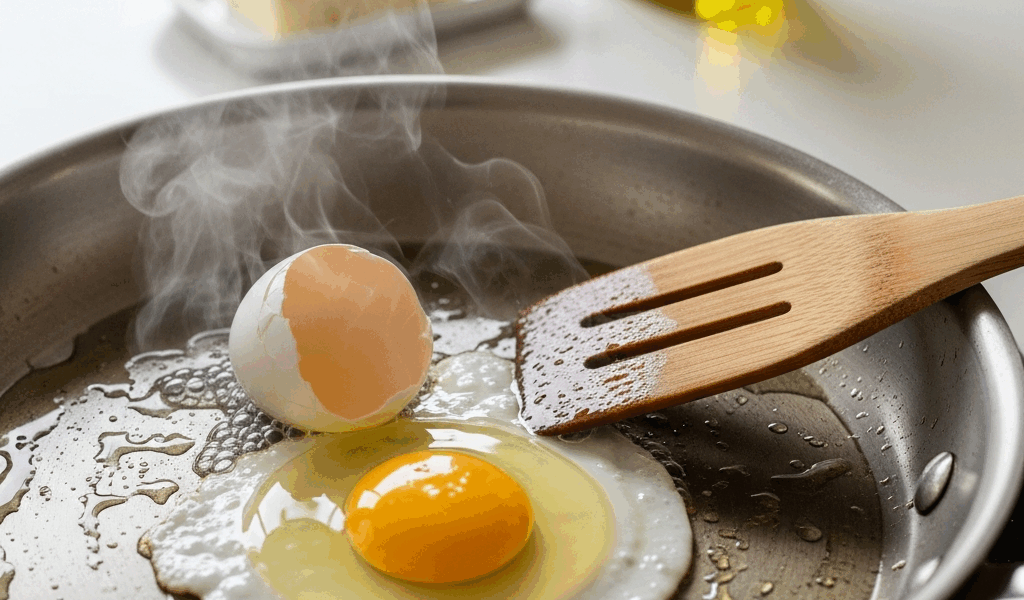
Fried Eggs Have Gotten Complicated With All the Conflicting Advice Flying Around
But what is the sticking problem, exactly? In essence, it’s protein bonding— egg proteins grabbing onto hot metal before a fat barrier has a chance to form. But it’s much more than that. The window where this happens is brutally narrow. Cold egg hits hot metal, bonding starts immediately, and if fat hasn’t fully coated that contact surface yet, you’ve already lost. The white tears when you slide the spatula under. Every time.
Here’s what drives me crazy about most cooking advice: everyone blames the pan first. “Buy nonstick.” “Cast iron ruins eggs.” That’s mostly wrong. Heat timing and fat choice cause sticking in roughly 85% of cases— I’ve confirmed this in my own kitchen and watching other people cook at every skill level. Pan type matters, sure. Just rarely as much as people think.
What follows is a troubleshooting checklist. One of these items is why your last batch failed. So, without further ado, let’s dive in.
Your Pan Temperature Is Off— Here Is How to Fix It
Most home cooks make one of two temperature mistakes. Both cause sticking. Neither is hard to fix once you know what you’re looking for.
Too Cold— The Slow Warm-Up Problem
Probably should have opened with this section, honestly. I made this mistake for two solid years before I understood what was actually happening underneath the egg.
You crack eggs into a pan that’s still climbing to temperature. Metal isn’t hot enough to activate the fat barrier properly. Proteins settle onto the surface and bond. By the time real heat arrives, those bonds are already set. You go in with the spatula and the white just shreds apart.
Test the pan before adding any fat— at least if you want a reliable result. Flick a single water drop onto the surface. If it beads up and rolls around, you’re ready. If it just sits there steaming slowly, keep waiting. Nonstick typically takes 2–3 minutes on medium heat. Cast iron needs 4–5 minutes because of thermal mass. Stainless steel often requires 5–6 minutes since hot spots develop unevenly and you need the whole surface stabilized.
Once the water beads properly, add your fat. Wait another 20 seconds. Then crack the egg. That sequence matters.
Too Hot— The Immediate Burn
Frustrated by scorched eggs, I’ve watched people reach for more fat, thinking extra butter will solve the problem. It doesn’t. You just end up with a burnt egg wearing a greasy hat.
An overheated pan cooks the bottom of the white so fast it welds to the surface before the middle even turns opaque. You get a rubbery, scorched edge and a completely raw center. Nothing about that is salvageable.
Medium to medium-low heat works almost every single time. On electric stoves, that’s dial position 5 or 6 out of 10. Gas should sit low enough that your hand can hover near the pan for several seconds without discomfort. Use the water bead test here too— if droplets skitter frantically and vanish in under a second, pull the pan off the heat. Wait 30 seconds. Test again. That’s your reset button.
Your Fat Is Wrong for the Pan You Are Using
Different fats behave completely differently at egg-cooking temperatures. That’s what makes fat selection cooking obsessives— there’s actual science underneath the habit. Your pan type determines which fat you should reach for.
Butter on Nonstick— Why It Fails
Butter’s smoke point sits around 350°F. A properly preheated nonstick pan runs 325–340°F for eggs— right at the edge. The milk solids brown and scorch at that temperature, leaving a sticky burnt film on the surface. The egg then bonds to that scorched butter layer, not even the pan itself. Don’t make my mistake of assuming more butter would fix this. It escalates it.
Clarified butter works better. Ghee works too— same concept, milk solids already removed, stable at higher temperatures. If you have neither on hand, mix one-third regular butter with two-thirds neutral oil— vegetable or canola both work fine. The oil pushes the smoke point up while the butter keeps the flavor honest.
Oil on Cast Iron— Why It Strips Seasoning
Cast iron needs fat that polymerizes— bonds chemically to the surface and builds up the seasoning layer over time. Avocado oil works well here. Refined grapeseed oil too. Olive oil doesn’t polymerize properly. Neither does coconut oil. Both smoke and degrade the seasoning instead of reinforcing it. I’m apparently an avocado oil person and Chosen Foods brand works for me while every olive oil I’ve tried on cast iron never holds up.
Apply whatever oil you use thin. The seasoning strengthens with every egg you cook, so the pan genuinely gets less sticky the more you use it correctly.
Butter on Cast Iron— The Right Move
Cast iron regulates temperature slowly and evenly. The seasoning layer adds insulation. Both factors mean butter browns less aggressively here than it would on stainless. Unsalted butter at medium-low heat works reliably. Clarified butter works too, though it’s not strictly necessary like it is with nonstick.
Stainless Steel— Why It Needs More Fat
Stainless steel is bare metal with zero seasoning layer. Eggs bond to it aggressively and without apology. You need a full tablespoon of fat per egg— not a light coating, an actual tablespoon. Yes, that’s more than feels reasonable. I use salted Kerrygold butter and let it foam for a full 10 seconds after it hits the pan. That foam means the water content has cooked off. The fat is ready. That’s your signal.
You Are Moving the Egg Too Soon— or Not Waiting at All
The release window is real. Eggs tell you when they’re ready to move— you just have to pay attention instead of prodding.
Watch the whites after the egg hits the pan. They’ll shift from translucent to fully opaque as proteins set. Once the whites are completely opaque and the edges have lifted slightly from the pan surface on their own, the egg is ready. At the right temperature, this takes roughly 90 seconds to 2 minutes. Not 30 seconds. Not “when it looks close.”
Going in with the spatula before this window closes tears the white. The proteins are still mid-bond. The fat barrier exists but hasn’t stabilized enough to let the egg release cleanly.
Set a timer for 90 seconds. When it goes off, tilt the pan gently. If the egg slides freely, you’re done underneath. If it doesn’t move, wait 15 more seconds and check again. Don’t poke it. Don’t shake the pan. Don’t slide the spatula under it to “just check.” You’ll break the fat barrier and the bonding process starts over from scratch. Just wait— at least if you want an egg that comes out in one piece.
The Pan Itself Might Actually Be the Problem
If you’ve dialed in temperature, fat, and timing and eggs still stick, the pan might genuinely be done. That happens. It’s not a failure, it’s maintenance.
Nonstick Coating Damage
Nonstick coatings degrade with use. Scratches, high-heat exposure, dishwasher cycles— all of it accelerates the breakdown. A magnifying glass on an older pan will show tiny cracks and worn patches where the coating is simply gone. Eggs stick in those spots because they’re hitting bare metal.
Replace the pan. A basic 10-inch nonstick skillet runs $20–60— Tramontina and OXO both make solid options in that range. Fighting a degraded surface isn’t worth the frustration.
Unseasoned or Damaged Cast Iron
A freshly stripped cast iron pan won’t have nonstick properties. You need at least 3–4 built-up seasoning layers before eggs will release reliably. If you recently scrubbed yours down to bare metal— which happens— eggs will stick until seasoning rebuilds through use.
Cook fatty foods to accelerate recovery. Bacon, sausage, fried potatoes. After 10–15 cooking sessions, seasoning comes back and eggs start releasing normally again. If the pan has deep pitting or rust that won’t scrub clean, that’s permanent damage. Replace it. Lodge 10.25-inch skillets run about $30 new.
Stainless Steel Hot Spots
Cheap stainless pans— anything under roughly $40— usually have uneven heat distribution baked into the design. One section runs significantly hotter than the rest. That section burns eggs while the cooler zones stay underdone. You can test this by heating the pan dry and scattering water drops across the whole surface. Uneven evaporation means hot spots.
Better stainless pans in the $60–100 range— All-Clad D3, Tramontina Tri-Ply— use copper or aluminum cores that distribute heat evenly across the entire surface. Worth the upgrade if stainless is your pan of choice and hot spots are your recurring problem.
Your eggs don’t stick because you’re a bad cook. One variable is off— temperature, fat, timing, or the pan condition itself. Test each one, fix what’s broken, and breakfast stops being a scraping exercise.

Stay in the loop
Get the latest home cuisine delights updates delivered to your inbox.