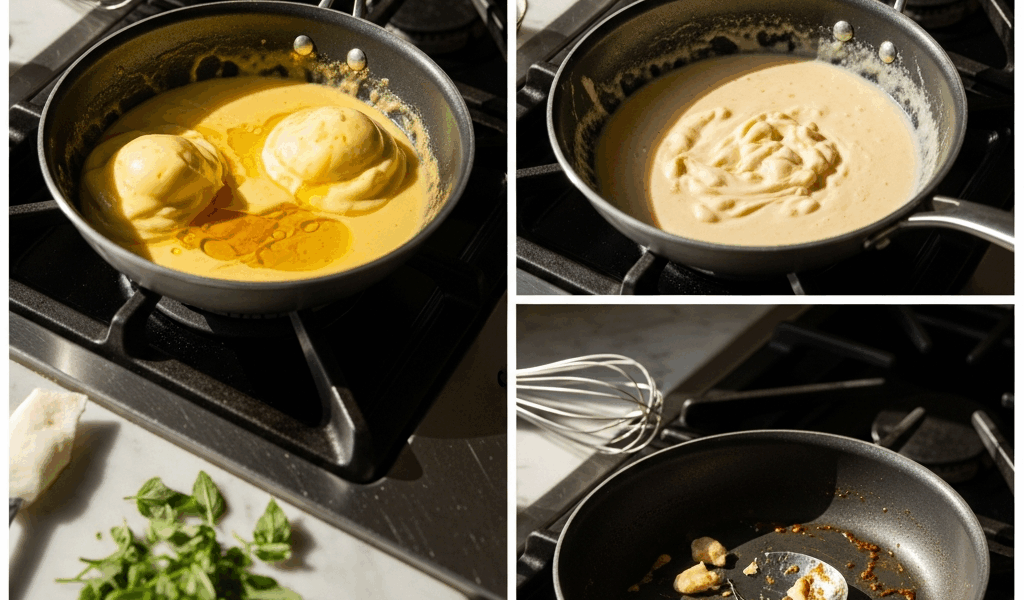
Why Your Sauce Breaks and How to Fix It Fast
Sauce troubleshooting has gotten complicated with all the emulsion science and food chemistry noise flying around. But when your hollandaise is separating ten minutes before guests walk through the door, you don’t need a lecture. You need a fix.
As someone who cooked professionally for years and then spent an embarrassing amount of pandemic time testing sauces in a home kitchen with a $40 induction burner, I learned everything there is to know about why sauces break — and more importantly, how to pull them back from the edge. Today, I will share it all with you.
So, without further ado, let’s dive in.
How to Tell Which Type of Sauce You Are Dealing With
Probably should have opened with this section, honestly. You’ve got about thirty seconds to diagnose the problem before you start making it worse. Three sauce types break in three completely different ways — and applying the wrong fix will absolutely destroy what’s left.
- Broken emulsion (hollandaise, beurre blanc, béarnaise): Greasy. Separated. Visible pools of fat floating above watery liquid. Your glossy sauce went gross.
- Curdled dairy sauce (cream sauce, cheese sauce, béchamel): Grainy, lumpy, cottage-cheese-adjacent. Heat and acid are usually the culprits.
- Broken pan sauce (red wine reduction, pan gravy): Thin, watery, slides right off a spoon when it should be coating it.
That’s what makes diagnosing it first so endearing to us home cooks — it takes ten seconds and saves the whole dish. Once you know what you’re dealing with, the rescue is straightforward.
How to Fix a Broken Emulsified Sauce Like Hollandaise or Beurre Blanc
Grab a warm bowl — run it under hot tap water, dry it fast. Crack in one fresh egg yolk. Whisk it alone for about thirty seconds. Now comes the critical part: drizzle your broken sauce into that yolk very slowly while whisking constantly. Start with literal drops. Four or five. Let them disappear into the yolk before adding more. Then a thin stream, barely a trickle. Keep the whisk moving the entire time.
Around the two-minute mark, you’ll feel resistance. The mixture thickens slightly — that’s your signal it’s holding. You can speed up the drizzle a little after that, but don’t get cocky. Don’t make my mistake.
But what is a broken emulsion, exactly? In essence, it’s fat and water that have split apart and stopped cooperating. But it’s much more than that. The egg yolk contains lecithin — a natural emulsifier — and when heat gets too high or fat gets added too fast, that lecithin essentially throws up its hands. The whole structure collapses in about fifteen seconds.
If it breaks again during the rescue: Your bowl probably isn’t warm enough, or the heat nearby is still too aggressive. Move everything away from the stove entirely. Start with a fresh yolk in a truly warm bowl. Add the broken sauce even more slowly — I’m talking drops for a full minute before you graduate to a stream. If it breaks a third time, abandon ship. Pivot to compound butter. Slice cold butter into pats, season them with whatever was supposed to go into your hollandaise, and serve it alongside instead. Nobody will know you pivoted. Seriously.
How to Rescue a Curdled Cream or Cheese Sauce
You’ve got something grainy and unpleasant where smooth, glossy sauce should be. Different problem. Different fix entirely.
Pull the pan off the heat completely. Add roughly two tablespoons of cold cream or cold whole milk per cup of sauce. Whisk hard for a full sixty seconds without stopping. The cold liquid drops the temperature fast — it shocks the sauce — and often unscrambles the proteins enough to smooth everything back out. If it works, return the pan to very low heat and whisk for another minute or two until it comes back together.
I’m apparently someone who learned this the hard way at least four times before it stuck. Pre-shredded cheese from a bag breaks way more easily than block cheese — those bags contain anti-caking agents, usually potato starch or cellulose, that interfere with clean melting. Block cheese, grated yourself, works for me while the bagged stuff never really does. A $12 box grater changed my cheese sauces permanently. Don’t make my mistake.
Tempering is your friend here: Adding cold cream or cold milk directly into a hot pan is asking for trouble. Heat your dairy separately — thirty seconds in the microwave, or a small saucepan on low — before whisking it in slowly. Restaurants do this automatically, without thinking about it. Most home kitchens skip it entirely. That gap explains a lot.
How to Bring a Broken Pan Sauce Back Together
Thin. Watery. Won’t coat a spoon. The flavor might actually be great — but structurally it’s falling apart.
Pull the pan off direct heat. Cut cold butter into small cubes — roughly half a tablespoon of butter per quarter cup of sauce. Whisk in one cube at a time. Wait for each cube to almost fully disappear before adding the next. This process is called mounting, and watching it work is genuinely satisfying. The sauce shifts from thin and watery to glossy and coat-able in about two minutes. The cold butter emulsifies into the liquid and gives it both body and shine.
But what is mounting, really? In essence, it’s using cold butter as a last-minute emulsifier. But it’s much more than that — it also concentrates the flavor slightly and adds a richness that makes a decent pan sauce taste like something from an actual restaurant kitchen.
If you over-diluted it: Mount it first with butter, then return the pan to medium-high heat and reduce it down to the right consistency. Stir constantly. Taste as you go. The flavors concentrate as liquid evaporates, and you have more control than you think. Most home cooks panic at thin sauce and assume it’s ruined — reduction is almost always available as a backup.
How to Stop Your Sauce From Breaking Next Time
Prevention beats rescue. Every single time, no exceptions. Restaurant cooks do three things automatically that most home cooks skip, and the gap is almost entirely habit rather than skill.
- Control the heat. Hollandaise lives at low-to-medium, never above. Cream sauces at medium-low. Pan sauces at medium until reduced, then drop to low before mounting butter. One burner setting too high ruins the whole thing. Patience here is not optional.
- Temper your dairy before adding it. Cold liquid into a hot sauce is a recipe for curdling. Heat it gently first — thirty seconds in the microwave works fine — or add it in a slow, thin stream while whisking. Don’t shock a warm sauce with cold anything and expect it to hold together.
- Add fat gradually. This applies to emulsified sauces and pan sauce mounting both. Speed is a trap. Slow and steady is not a metaphor here — it’s literally the technique. Most home cooks rush this one step more than any other, and that’s where the breaking happens.
None of this is complicated. It’s just three habits stacked on top of each other. Build them, and your sauces stop breaking. It really does work out that cleanly.


Stay in the loop
Get the latest home cuisine delights updates delivered to your inbox.