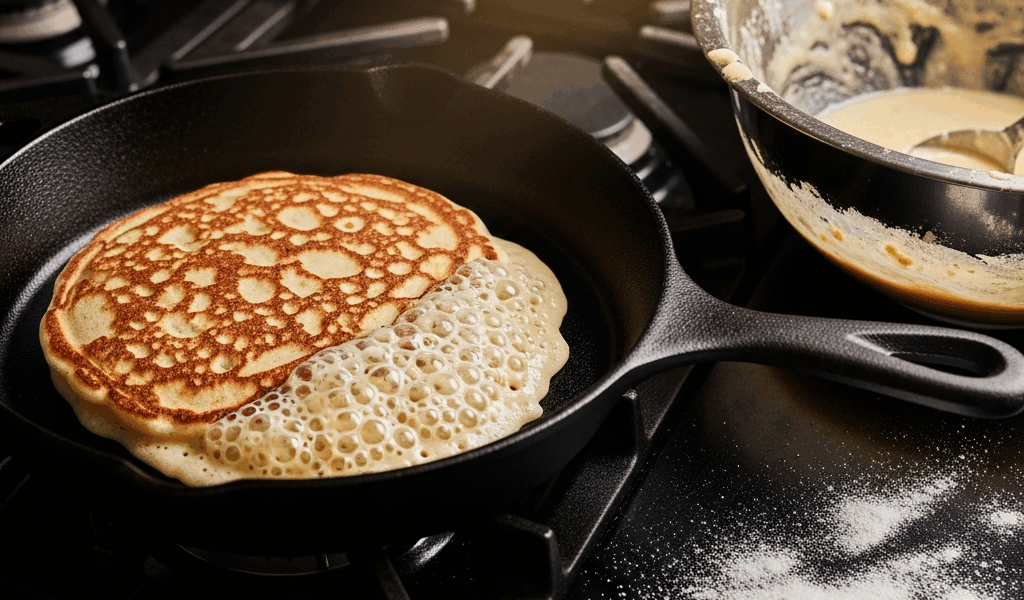
The Real Reason Pancakes Go Flat
Pancake troubleshooting has changed with all the conflicting advice flying around. Everyone’s got a tip. Add club soda. Use cake flour. Let the batter rest overnight. But honestly, most of that noise distracts from the one thing actually going wrong in your pan.
Here’s the short version: your pancakes go flat because something murdered the carbon dioxide bubbles before they could set inside the batter. That’s the whole diagnosis. Everything else— the dense texture, the way they stick to your teeth, that weird rubbery chew— traces back to dead bubbles.
A baker friend asked me once what I thought made pancakes rise. I mumbled something about eggs and baking powder “working together.” She stopped me cold. “Bubbles,” she said. “Tiny CO2 bubbles trapped in the batter. Kill the bubbles, you kill the fluff.” That was three years and probably 200 failed pancakes into my career as a mediocre weekend cook.
Three culprits kill those bubbles: dead leavening agents, overmixed batter that physically can’t hold gas, or batter that sat around long enough for everything to deflate before hitting the pan. Probably should have opened with this section, honestly— because every fix below connects back to one of those three problems.
Your Baking Powder Is Probably Dead
This is the most overlooked cause. I’d bet actual money it’s your issue right now.
Baking powder isn’t stable forever in your cabinet. The reaction that creates CO2 happens during mixing and again during cooking— but if your powder has already absorbed moisture from the air or slowly oxidized sitting in that spice cabinet since 2021, it won’t generate enough gas when you actually need it. You mix a batter that looks completely normal, pour it onto a hot pan, and watch it spread flat like a sad crepe instead of puffing up.
The fix is almost insultingly simple. Drop a teaspoon of your baking powder into a glass of hot water. If it fizzes and foams immediately, it’s alive. If it just sinks and sits there doing nothing— it’s dead. Replace it. A fresh container of Rumford or Bob’s Red Mill runs about $3.00 and lasts most home cooks six months to a year, depending on your kitchen humidity.
The correct ratio is one full teaspoon of baking powder per cup of flour. Not three-quarters. Not a “generous pinch.” One teaspoon, measured. I started obsessively measuring this after my flat-pancake phase and the difference was immediate and embarrassing— embarrassing because the fix was that obvious.
But what about baking soda? In essence, it’s a base that creates CO2— but it needs an acid in the batter to activate. It’s much more than a simple swap for baking powder. Buttermilk works, yogurt works, even a tablespoon of lemon juice works. Without that acid, baking soda just sits in your batter tasting vaguely metallic and doing nothing useful. Baking powder already has the acid built in, so it just needs moisture and heat. Totally different activation. Don’t swap them one-for-one. Don’t make my mistake.
Overmixing Kills the Batter Every Time
Stir that batter too long and you develop gluten— the same elastic protein network that gives bread its chew and structure. That’s what makes bread bakers. In pancakes, it’s a disaster.
Gluten forms a web of elastic fibers. Mix longer, the web gets tighter. A tight, elastic batter can’t expand to trap and hold the CO2 bubbles your leavening creates. The bubbles escape immediately or rupture the second you try to flip. What you’re left with is a dense, rubbery disc that tears wrong and chews like a car mat.
Properly mixed pancake batter should look genuinely lumpy— walnut-sized flour clusters visible in the bowl. Most home cooks see those lumps and panic. They think something is broken. Nothing is broken. Those lumps cook out in the pan. Your actual job is to stop mixing the second everything barely comes together— even if you still see dry flour streaks along the bowl edge. Especially then.
Use a wooden spoon or a rubber spatula. Not a whisk, definitely not a KitchenAid. Pour wet into dry, then fold— scoop from the bottom, turn it over the top— maybe eight to ten times. Your arm should feel basically nothing. If your arm is tired, you’ve already gone too far.
Overmixed batter feels smooth and almost silky. It pours like thick sauce rather than chunky slurry. I’m apparently someone who finds that silky texture satisfying to achieve, and it cost me years of bad pancakes. By the time batter looks that smooth, the gluten damage is done. Cook it if you want proof— but no amount of perfect pan temperature or fresh baking powder will save it at that point.
Pan Temperature Makes or Breaks the Cook
Too hot: the outside burns before the inside sets— you get a dark, almost crispy shell wrapped around a pale, gummy center. Too cold: the batter spreads flat and just steams instead of searing, producing something closer to a sad crepe than an actual pancake.
Medium heat. Not medium-high. Medium.
Here’s how to actually dial it in. Heat your pan— cast iron, nonstick, whatever you have— then add a thin pat of butter. Watch it. When the foam from the butter subsides and the edges just barely start to brown, the pan is ready. On a standard electric stove that takes roughly three to four minutes. Gas runs faster— closer to two minutes. Every stove is different. I have a 1990s-era GE coil stove and medium means literally the 5 position on the dial.
The water-droplet test works too. Flick a few drops onto the surface. They should skitter around and evaporate in about two seconds. Gone in under a second— too hot. Pools and sits— needs more time.
That first pancake almost always comes out wrong. Too pale, spreads too much, sticks a little. So home cooks immediately crank the heat. Pancake two burns. They get frustrated. Pancakes three through six are all either scorched or flat while they keep chasing the right temperature. The first pancake is a calibration test. That’s its whole job. Cook it, look at it, adjust— then cook the rest.
Quick Fixes You Can Use Right Now
Before pouring the next batch, run through this three-step triage:
- Test your baking powder in hot water. No fizz means replace it before you do anything else.
- Mix the batter and stop while it still looks lumpy. Visibly, obviously lumpy. Overmixing is the enemy.
- Let the batter rest five minutes before you pour. This gives the leavening time to hydrate fully and lets the gluten relax slightly from whatever mixing stress you put it through.
One bonus move worth trying: swap half your regular milk for buttermilk. The lactic acid activates any baking soda in the recipe and adds extra lift without dramatically changing the flavor profile. A quart of Organic Valley buttermilk runs about $4.50 at most grocery stores, lasts around two weeks in the fridge, and will transform noticeably flat pancakes into tall ones. I’m apparently a buttermilk convert now and regular milk-only pancakes never quite do it for me anymore.
So, without further ado, let’s recap what actually matters here: dead leavening, overdeveloped gluten, or a pan running at the wrong temperature. Pick whichever one matches your particular disaster, fix that one thing, and your next batch will rise, set cleanly, and actually taste like pancakes— not the dense, rubbery disappointment you’ve been tolerating every Sunday morning.


Stay in the loop
Get the latest home cuisine delights updates delivered to your inbox.