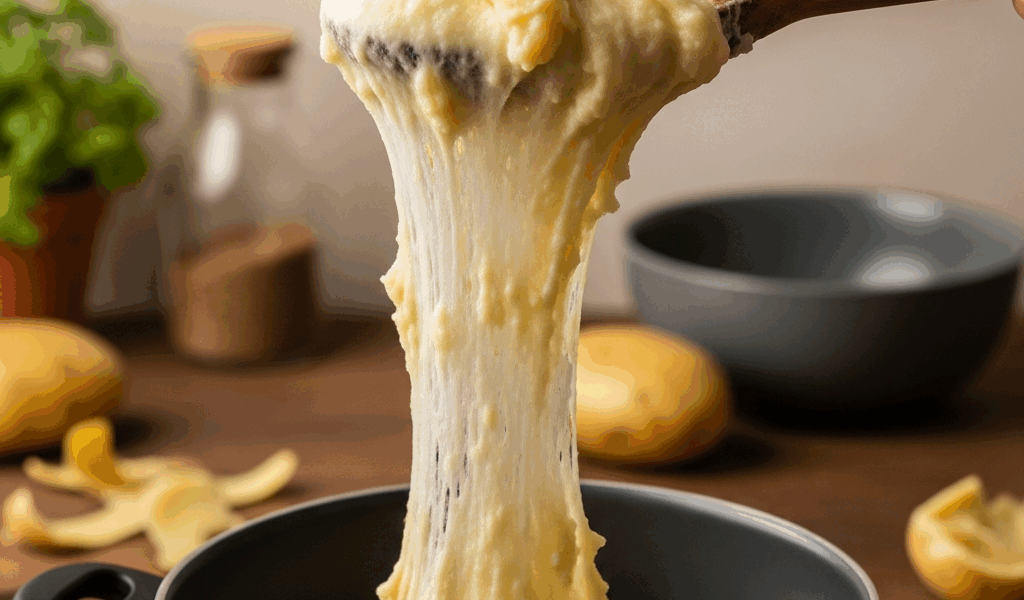
What Makes Mashed Potatoes Go Gluey
Mashed potatoes have gotten complicated with all the conflicting advice flying around.
So what makes mashed potatoes gluey? In essence, it’s overworked starch. But it’s much more than that. Potato cells hold starch granules suspended in water. Heat softens those cells during cooking. The second you start mashing, cell walls rupture— and out comes everything stored inside. Two molecules, amylose and amylopectin, soak up the liquid and any dairy you’ve added, then gelatinize under heat and mechanical stress. Keep mixing after that point and you’re making paste. Literal paste.
That’s what makes your grandmother’s “don’t overmix” warning — it sounds like vague kitchen folklore, but it has real teeth. We’re talking the difference between potatoes that taste like food and potatoes that taste like something you’d use to hang wallpaper.
You Probably Started With the Wrong Potato
Probably should have opened with this section, honestly. Before technique even enters the conversation, your potato variety is already deciding your outcome— and most recipes just… skip over this entirely.
Red potatoes and fingerlings are waxy varieties. Less starch, more moisture. They release less starch during mashing, which sounds like a win, but their high water content means they turn gluey under almost any mixing action at all. I learned this at Thanksgiving 2019 when I grabbed red potatoes because they were on sale at Whole Foods— $2.99 per pound versus $1.49 for russets. My brother-in-law spent the whole dinner politely pushing dense, gummy potatoes around his plate. Don’t make my mistake.
Russets and Yukon Golds are where you want to be. Russets run high starch, low moisture— practically engineered for mashing. Yukon Golds are slightly more forgiving and buttery, which is why they’ve become the home cook’s safety net. Either one works. Either one fails far less often than anything waxy.
The Mixing Method Is Where Most People Go Wrong
Here’s the core problem. Most home cooks reach for a hand mixer or a blender. Both are mistakes— at least if you want anything resembling fluffy potatoes.
A hand mixer runs fast and creates exactly the mechanical stress that ruptures cells and overworks starch. A blender is worse. It’s designed to pulverize things. I tested this with three batches of Yukon Golds last November: a KitchenAid hand mixer, an immersion blender, and a basic manual ricer from OXO. The mixer and blender batches went gluey inside two minutes. The ricer batch— finished by folding butter and cream in by hand with a wooden spoon— stayed light and almost pillowy.
While you won’t need any professional equipment, you will need a handful of basic tools worth actually thinking about. A ricer is the best option, as mashed potatoes require minimal cell disruption. That is because forcing potatoes through small holes mimics the breakdown from cooking without adding the mechanical stress of stirring. Decent ricers run $20 to $40— the OXO Good Grips model is around $30 and holds up well. No ricer? Use an old-school masher with a flat or waffle-shaped head. Not the tines-style one. Those do nothing useful.
Stop mixing the moment things look just combined. Not smooth. Not glossy. Just combined— small lumps still visible. Residual heat handles those lumps on their own. That’s the target texture before resting, not after.
Heat accelerates the starch problem. The warmer your potato mass stays during mixing, the more everything gelatinizes and thickens. Work quickly. Don’t let potatoes cool before starting— cold mashing needs more pressure and more time, both of which make things worse. But don’t let them sit over the burner either while you’re warming dairy. Get them into a bowl and keep moving.
Temperature and Timing Mistakes That Make It Worse
Several things go wrong before you even pick up a masher. First, you should drain your potatoes immediately— at least if you boiled them and plan to walk away for a few minutes. Potatoes left sitting in hot water absorb extra moisture and turn waterlogged. Start mashing those, and you’re essentially mashing soup.
Cold dairy might be the sneakiest culprit, as mashed potatoes require consistent warmth throughout mixing. That is because cold milk or butter added to warm potatoes drops the overall temperature, which forces more aggressive mixing to incorporate everything— which means more starch activation and more glue. Warm your milk for 45 seconds in a small Pyrex measuring cup. Cut butter into small pieces and leave it on the counter for five minutes first. Room-temperature additions fold in with almost no effort.
Improper draining trips people up too. Use an actual colander after boiling— don’t just tip the pot. And skip rinsing entirely. Rinsing washes away starch you actually want to keep inside the potato for the right texture.
I’m apparently sensitive to the cold dairy issue specifically, and warming my milk works for me while skipping that step never does. Found that out the hard way at Christmas 2021. Twice in a row.
How to Fix Gluey Mashed Potatoes If It Already Happened
But what is a truly overworked batch of mashed potatoes? In essence, it’s compromised starch that can’t fully be reversed. But it’s much more than a lost cause.
Spread the gluey potatoes across a wide skillet over low heat. Stir gently for three to five minutes— the heat drives off some moisture and improves texture slightly. Add extra fat, roughly one tablespoon of butter per cup of potatoes, and fold it in slowly. Fat disrupts the starch network and cuts that pasty mouthfeel.
If they’re beyond saving as a side dish, repurpose them. Gluey mashed potatoes make excellent potato cakes— form into patties, pan-fry in butter until golden on both sides. Or fold them into gnocchi dough, where the extra starch actually helps with binding. They’re not wasted. They’re just in their second act.
So, without further ado, here’s the short version going forward: russets or Yukon Golds, ricer or hand masher, dairy warmed before adding, mixing stopped the moment things come together. That was the method I landed on after the 2019 Thanksgiving disaster. Haven’t turned out a gluey batch since.



Stay in the loop
Get the latest home cuisine delights updates delivered to your inbox.